The short answer: a wood fence costs less on the day it goes in but asks for cleaning and resealing every few years to stay healthy in Gulf Coast humidity, while a vinyl fence costs more up front and then asks for almost nothing beyond an occasional rinse for decades. Wood wins on upfront price and natural looks; vinyl wins on long-term maintenance and coastal weather resistance.
Wood or vinyl is the fork most Gulf Coast homeowners hit the moment they decide to fence the yard. Both can be built as a full privacy fence at the same height, both look good the day they go in, and both will do the job for years. The real differences show up in what you pay at the start, what the fence asks of you afterward, and how each material behaves in a hot, humid, salt-touched climate. Here is the honest version, without pushing you toward the one with the bigger margin.
Wood vs. Vinyl at a Glance
- Upfront cost: wood is the least expensive common privacy fence to install; vinyl runs noticeably higher for the same line because the material itself costs more.
- Maintenance: wood asks for a wash and a fresh coat of sealer every few years on this coast; vinyl asks for a hose rinse and little else.
- Lifespan: a well-kept wood fence reaches the end when posts and pickets finally give in to moisture; vinyl typically outlasts it in this climate when the posts are set right.
- Coastal climate: humidity and salt air work on wood constantly; vinyl shrugs off both, though hurricane-grade wind is a real test for either material.
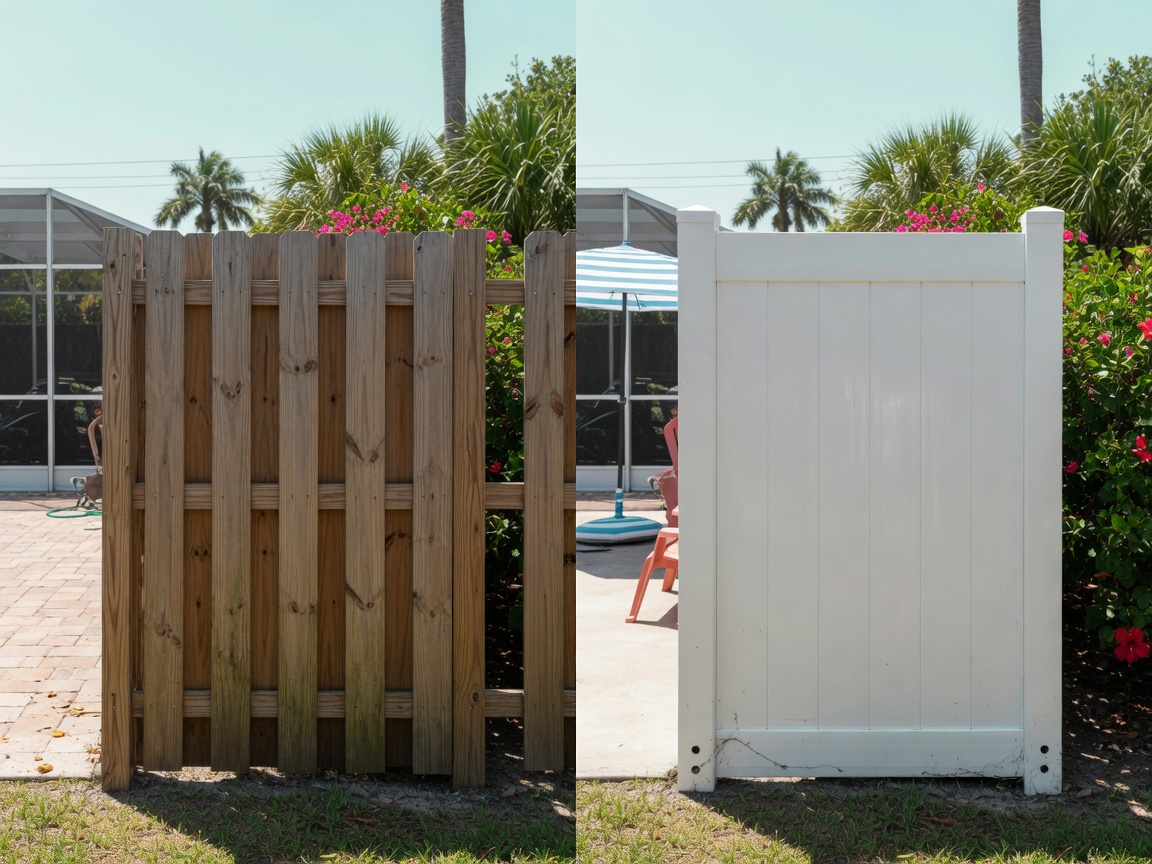
- Look and feel: wood is warm, natural, and paintable; vinyl is uniform and clean-lined but photos flatten the difference, so walk both in daylight.
Upfront Cost: What Actually Drives the Price
The most useful thing to understand about cost is not a dollar figure, since prices move with the market, the yard, and the spec. It is the pattern. As a rule, a vinyl fence costs more up front than a comparable wood fence, because the manufactured panels and posts are a more expensive material than dimensional lumber. What you are buying with that higher upfront number is a fence that asks less of you later.
What Moves Both Quotes
Beyond the material itself, the same things drive both quotes: the total length of fence, the height, how many gates you need, the terrain and how level the yard is, and how much old fence has to be removed first. A steep or wooded lot costs more to fence in either material.
Gates and corners add up
Gates are the most labor-heavy part of any fence, so a layout with several gates or many corners costs more than a simple straight run of the same length, in either material. It is worth counting your gates before you compare two bids.
Old fence removal is a real line item
If there is an existing fence to tear out and haul off, that is real labor and disposal, and it applies whether you land on wood or vinyl. Ask whether removal is included so you are comparing like for like.
That is why the honest move is to get the exact same layout quoted in both materials rather than compare a generic "wood price" to a generic "vinyl price."
Maintenance: The Real Long-Term Difference
This is where the two materials genuinely diverge, and it is the section that should drive your decision more than the sticker price.
What Wood Asks of You
Wood is a natural material and it needs periodic care to look its best and last: cleaning, and resealing or restaining every few years to protect it from sun and moisture. Individual boards can warp, split, or need replacing over the life of the fence. None of that is hard, but it is real, recurring work, or a recurring cost if you hire it out.
On the coast the schedule tightens
Humid, salt-touched air is harder on a wood finish than dry inland air, so the reseal interval that a national guide quotes tends to be optimistic here. Budget for a little more diligence, not less.
What Vinyl Asks of You
Vinyl, by contrast, is close to hands-off. It does not need staining or sealing, and its color runs through the material rather than sitting on the surface, so it does not peel. Cleaning is usually a hose and occasionally soapy water. If low maintenance is high on your list, this is vinyl's strongest argument, and it is the one that most often justifies the higher upfront price for people who do not want a weekend project every few years.
Lifespan and Durability
Both materials last a long time when installed well, but they fail in different ways, and understanding how each one fails tells you more than any lifespan number.
How Wood Reaches the End
Wood's enemies are moisture and insects over time; a well-built, well-maintained wood fence lasts many years, and because it is board-and-rail construction, damage is usually repairable one piece at a time. That repairability is a quiet advantage. A single failed board is a cheap afternoon, not a whole panel.
How Vinyl Reaches the End
Vinyl does not rot or feed insects, but a hard impact, a falling limb, a mower, a backed-up trailer, can crack a panel, and a cracked panel is replaced as a unit rather than patched. Neither material is "more durable" in the abstract; they are durable against different threats.
The repair question is really the durability question
When you ask which lasts longer, what you usually care about is which is cheaper and easier to keep looking right over the years. Wood answers that with board-by-board fixes; vinyl answers it by rarely needing a fix at all, but charging more when it does.
Humidity, Salt Air, and the Coastal Climate
This is the section that matters most here and gets ignored in national comparisons. On the Gulf Coast, a peninsula sitting between Pensacola Bay and Santa Rosa Sound, the air is humid year-round and carries salt near the water.
Why the Climate Is Harder on Wood
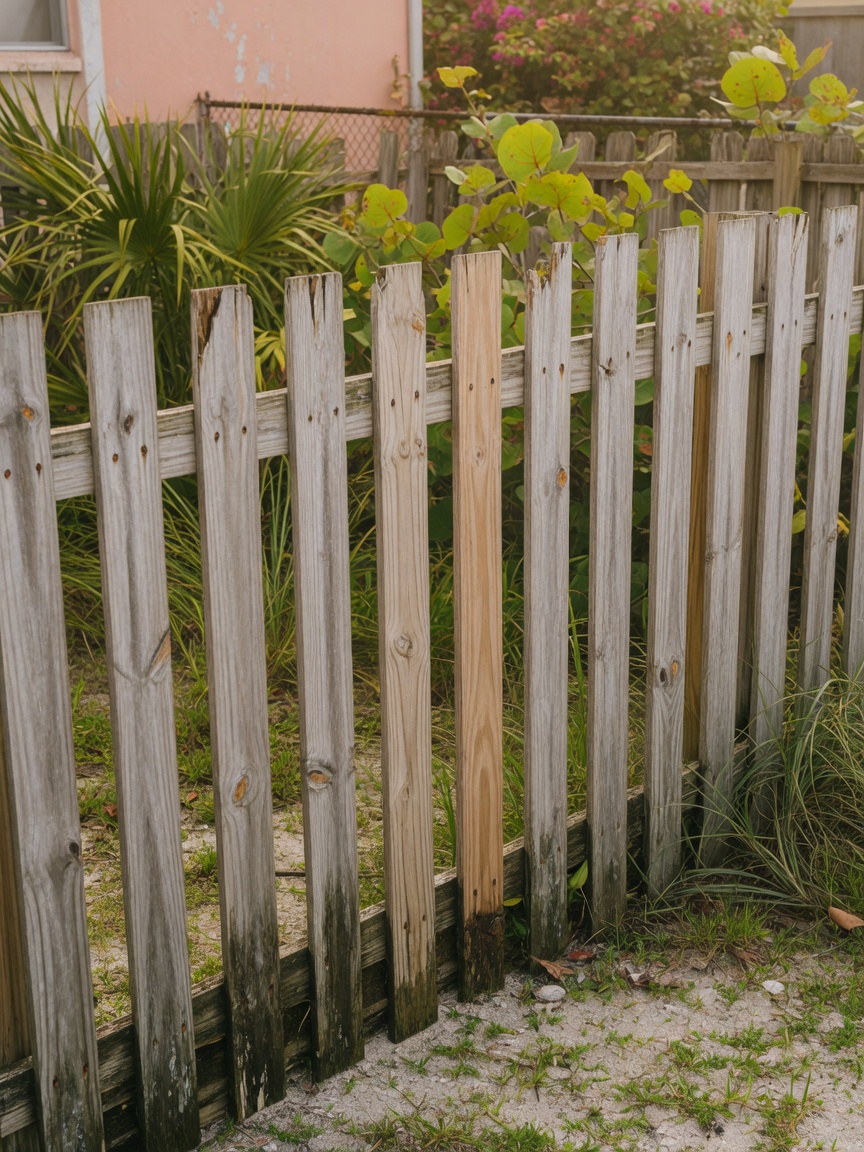
That environment is harder on wood than it is inland: wood in humid, salt-touched air needs more diligent sealing to hold off moisture, and the wet-dry cycling that comes with coastal weather works on the boards over time. Vinyl does not rot or corrode, so humidity and salt air simply do not attack it the way they attack an unsealed wood fence. That single fact is why a lot of near-water homeowners lean vinyl even at the higher upfront cost.
The wet-dry cycle is the slow enemy
It is not one rainstorm that tires wood out. It is the constant swing between saturated and dry that opens grain, lifts fasteners, and cups boards over years. A good finish slows that cycle down. It does not stop it.
The Wind Caveat Cuts Both Ways
One caveat cuts the other way: any tall, solid privacy fence, wood or vinyl, is a wall the wind wants to push over, and storm season is real here. In both materials, what carries the fence through a blow is the post depth and hardware underneath, not the panel brand on the front. That is the part our crews never cut, because a Gulf fence that looks good for one season is a failure.
Appearance and Feel
Cedar and other natural woods give a warmth and grain that many people simply prefer, and wood can be stained to almost any tone. Vinyl offers a clean, uniform, manufactured look that some love and some find plasticky. This one is not an argument you can win with facts. It is a matter of taste, and it is worth walking a couple of finished fences of each type before you decide.
How each one ages in the sun
Left unsealed, wood weathers toward a silver-gray patina that some homeowners love and others do not. Vinyl holds its color far longer because the pigment runs through the material, though any surface outdoors mellows a little with years of Florida sun.
Matching a color later
If you may extend the fence in a few years, know that a sun-mellowed vinyl or a weathered stain can be tricky to match exactly, so it is worth deciding your final layout up front where you can.
Taste note
There is no right answer here. Walk a finished fence of each kind in daylight before you commit, because photos flatten the difference.
So Which Should You Choose?
Choose wood if you want the lowest upfront cost, prefer a natural look, and do not mind resealing every few years to keep it healthy in this climate. Explore it on our wood and privacy fence page. Choose vinyl if you would rather pay more once and then do almost nothing, and you value a material that shrugs off humidity and salt air, see our vinyl and composite fence page. There is no wrong answer; there is only the answer that matches your budget and how you want to spend your weekends.
Have Us Quote Both
Because the price gap depends entirely on your specific layout, the smartest thing you can do is have the exact same fence quoted in both materials and compare. Show us the yard once, and we will price wood and vinyl side by side. As a fence company in Gulf Breeze, FL that builds for this coast, we can also tell you which material has actually held up better on lots like yours, the kind of local read a national comparison chart cannot give you.
What a Homeowner Who Installed Both Says
It is one thing for a fence company to compare materials, and another to hear from someone who paid for both out of his own pocket. Scott of Lacey Family Farm installed a wood fence and a white vinyl fence himself, priced every component, and filmed the comparison. His numbers, at September 2023 lumber prices: one segment of pressure treated wood fencing came to 75 dollars and 66 cents in parts, while one segment of white vinyl came to 181 dollars and 17 cents, more than double. His verdict after living with both:
- Longevity: in his words, a typical wood fence "if properly maintained, which let's be honest not many people actually do, will last you about 15 years," while the vinyl "will last 20 to 30 years if not longer."
- Maintenance he actually did: the wood asked for resealing and replacing cracked pickets; for the vinyl, "the only maintenance you should do is spray it off just to keep it clean."
- Labor counts double for wood: his point on installation cost is that you pay to install a wood fence "once for installing it and a second time for installing it," versus once for vinyl, and that alone "would make up for all of the cost associated with the difference."
- His regrets: none. "We've had zero issues with it whatsoever... I just wish I would have done it sooner." Over a 30 year horizon he concludes the wood "would have needed to been replaced once if not twice already."
That is one homeowner, one climate, and one budget, but it matches what we see on the coast: the upfront gap is real, and the maintenance gap is bigger than most people expect.
Source: Lacey Family Farm, "Wood vs White Vinyl Fencing: Which is More Budget-Friendly?" (September 2023). Prices quoted are his, from that date; coastal quotes differ, which is why we price both materials on your exact line.
Wood vs. Vinyl Fence FAQ
Is a wood fence cheaper than a vinyl fence?
Yes, on installation day. Wood is usually the least expensive way to build a full-height privacy fence, while vinyl costs more up front. Over the years the gap narrows, because wood needs periodic cleaning and resealing that vinyl never asks for.
How often does a wood fence need to be resealed on the Gulf Coast?
Every few years. Gulf Coast humidity and salt air work on wood constantly, so a wash and a fresh coat of sealer on a regular cycle is what keeps a wood fence healthy here.
Does vinyl fencing hold up to salt air and humidity?
Yes. Vinyl does not absorb moisture the way wood does, so humidity and salt air have very little to work on. An occasional rinse is the whole maintenance program for most vinyl fences on this coast.
Which lasts longer, a wood fence or a vinyl fence?
In this climate, vinyl typically outlasts wood when both are installed correctly. A wood fence reaches the end when moisture finally wins against the posts and pickets; vinyl avoids that failure mode entirely.
Should I get the same fence quoted in both materials?
Yes. The price gap depends entirely on your layout, so the smartest move is to have the exact same fence line quoted in wood and in vinyl and compare the two numbers side by side. We price both in one visit.
Talk to us
Start on our fence company in Pensacola, FL or send us a quote request.
Wood side
Privacy panels, cedar, and repairs we build: wood & privacy fences.
Vinyl side
Low-maintenance panels we install: vinyl & composite fences.